본문


-
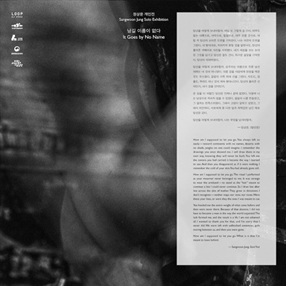
전시 포스터
-
정상운
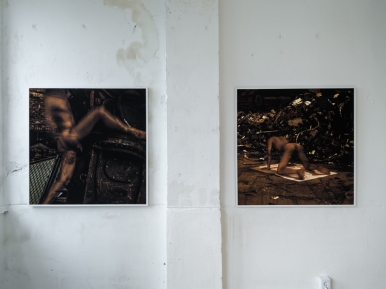
정(을지로), 2025. 종이에 아카이벌 피그먼트 프린트, 100×100cm, 서울
-
정상운
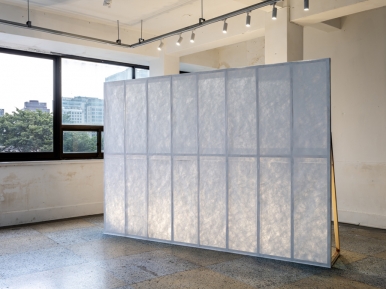
지도 6, 2026. 종이에 선각, 목재에 철부식 페인트, 218.2×315.2cm, 서울
-
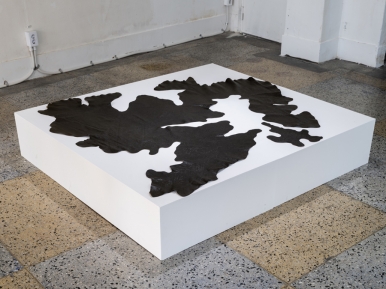
정상운
지도 7, 2026. 가죽에 박, 165×150cm, 서울
-
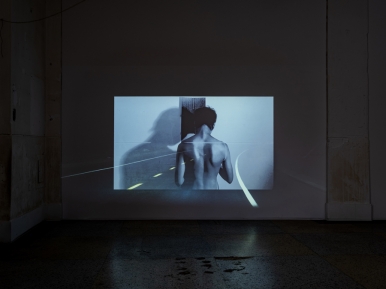
정상운
Alpha. Bravo. Charlie, 2022-2025. 단채널 비디오, 10'53”, 서울
-
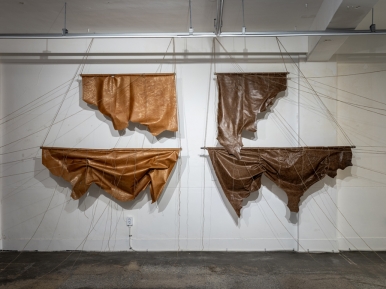
정상운
돛대2, 2024. 가죽에 박, 동관, 밧줄, 가변 크기 , 서울. 돛대1, 2024. 가죽에 박, 스테인리스 관, 밧줄, 가변 크기, 서울
-
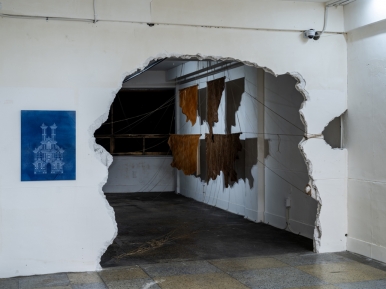
정상운
솟은 문, 2026. 종이에 시아노타입, 60.6x80.3cm, 서울
-
Press Release
A sail rises. Colonial rule has ended, and in its place comes division and a proxy war of the Cold War. Two families cross south and become one; Two generations of patriarchs labour in distant lands, and a homosexual son is raised in their absence. Last autumn, Sangwoon Jung lost his father and stood as chief mourner at his funeral. In the context of a reproductive futurism¹ that shackles heteronormative social order to the future through the figure of the Child, Jung’s queer body wanders on the periphery. It Goes by No Name is the mourning process of a son left behind with nothing to pass on, anchored by the memory of his father’s silhouette (Jung (Phu Quoc) (2023)).
Jung has practised cruising—the act of walking or driving through a locality in search of chance encounters within the gay community—as a way of bringing his body into contact with the city and its interstices. Although cruising is often associated with sexual deviance, it also functions as a way for alienated bodies to endure the estranged time of exclusion, growing intimate with a time and place left outside collective history. Jung wanders the city after dark, searching for abandoned gaps and forms thrust upwards from the ground. In the self-portrait series Jung (Euljiro) (2025), he places himself among Euljiro’s rusted machinery, dismantled construction materials, and tangled steel frames. He twists his limbs, shifts positions, and lays his body for long stretches of time. He edges, and edges again. As this endurance settles into the lens, afterimages surface. What no longer exists still lingers, and what has not yet arrived is already coming into view.
Like mucus expelled from the body, Gene (2026) oozes out of the dried-out cracks and holes in the wall and spills onto the floor. Jung transforms these unborn seeds into a map of constellations that reveal “broken promises”, “unrealised plans” and “unbuilt structures”. His mapmaking process resists the conventional impulse to survey, divide, and seal. Instead, he stitches the memories and fictions left in the wake of a body, giving forms to routes that are yet to take shape. Their lines branch out like limbs or veins, each organically taking a shape of its own without directly naming places that already exist. As they reach towards one another, they become one continuous map.
The continuation of these lines calls forth a long voyage. Tracing the remains of war and colonial rule, ruptured borders, and lives uprooted from place to place, Jung moves between South Korea, Germany, and Vietnam. Alpha. Bravo. Charlie.(2022–2025) layers ruins, overpasses, and hole-punctured walls with the afterimages of the bodies that passed between them. Yet, this voyage does not lead solely towards a new geopolitical order or an unknown future. Drawing on Sara Ahmed, feminist queer theorist Jasbir K. Puar cautions that once queerness is imagined as the freedom to slip free of every norm, freedom itself becomes a border: a measure separating those who can leave from those whose lives remain bound by unequal conditions. What emerges is the liberal fantasy of a subject wholly in possession of itself, operating under the assumption that power, ideology, and the ties of family could simply be cast off. Within this fantasy, agency becomes visible only as resistance, while the quieter acts that take shape through dependence, compromise, and entanglement with norms fall from view. ²
Jung claims the figural position into which his body and sexuality are cast: a break in the promise of continuation. At the same time, he remains bound to and dwells within the structures that produced that resistance. Architectural drawing was the tool through which his father made a living, and the foundation of Jung’s own visual language. For years, Jung has drawn blueprints for buildings that will never be constructed, such as Spire Gate (2026), which subdues Western forms in favor of Korean and East Asian architecture. This alludes to the wound of national inferiority inscribed by colonial hierarchy, merging together with the desire that mutates this wound into a longing for dominance and supremacy, echoing the relation between Jung’s body and the city. Each occupies and intrudes upon the other; each is occupied and intruded upon in return. Jung does not force these inherited forms towards redemption, nor does he straighten them into a future they are expected to serve. He accepts their crookedness, loosening the constraints they have inherited and allowing them to lean elsewhere. His work does not leave the past behind; it turns within it, shifting its course little by little.
Through repeated edging toward a climax that never arrives, penetration grows easier. The traversing line—the breadth of forbidden, uninhabited ground, the interstice of the strait—gradually loosens.
— Sangwoon Jung, from the working notes Night, Something Formless and Slippery Enters the Strait
The line that threads its way through loss does not remain within a single body. It charts a route along which relations not yet named take shape, force is shared rather than seized, and the settled order of what counts as common sense—and what does not—is set slightly askew. This is a route along which numerous bodies move together; raising the sail, then lowering it again.
Written by eunseo Kim (Assistant Curator, Alternative Space LOOP)
Edited by Colleen Dalusong
¹ Lee Edelman, No Future: Queer Theory and the Death Drive (Duke University Press, 2004), pp. 2–3.
² Jasbir K. Puar, Terrorist Assemblages: Homonationalism in Queer Times (Duke University Press, 2007), pp. 22–23; Sara Ahmed, The Cultural Politics of Emotion (Edinburgh University Press, 2004), pp. 151–152.
돛을 올린다. 식민 지배가 끝난 자리에 들어선 분단과 냉전의 대리전, 월남한 두 집안이 남쪽에서 이룬 가족, 국가의 외화벌이를 위해 해외로 파견된 할아버지, 아무도 없는 먼 땅을 오가며 노동한 아버지, 그리고 그의 부재 속에서 성장한 호모섹슈얼 아들. 정상운은 지난 가을 아버지를 떠나보냈고, 상주의 이름으로 장례를 치렀다. 이성애 규범적 사회 질서를 ‘아이’의 형식으로 미래에 기워 붙이는 재생산적 미래주의¹의 징후들 속에서, 그의 몸은 겨우 머문 채 헤맨다. 전시 《남길 이름이 없다》는 아버지의 옆모습(〈정(푸꾸옥)〉(2023))을 기억하며, 남겨졌으나 남길 것 없는 아들이 자신만의 애도의 방식을 갖추는 과정이다.
정상운은 크루징 — 게이 남성들이 우연한 만남을 위해 공공장소나 길거리를 배회하는 행위 — 을 도시와 그 틈새에 몸을 접촉시키는 방식으로 수행해 왔다. 크루징은 흔히 퀴어 개인의 일탈적 섹슈얼리티와 결부되곤 하지만, 이는 집단의 역사로부터 밀려나 비가시화된 몸이 소외의 시간을 견디며 장소와 관계 맺는 방식이기도 하다. 그는 검은 어둠이 내려앉은 도시를 헤매며 유기된 틈, 혹은 솟아오른 것을 찾는다. 전시장에 재현된 비좁은 길목에 놓인 셀프 포트레이트 연작 〈정(을지로)〉(2025)에서 작가는 을지로의 녹슨 중장비와 해체된 건축 자재, 뒤엉킨 철골 사이에 스스로를 위치시킨다. 이어 사지를 뒤틀어 체위를 바꾸고, 몸을 시간의 양 끝에 뉘인 채 끝없이 미끌거리기를 반복한다. 이 버텨냄이 렌즈를 경유할 때, 보이지 않지만 분명히 남아 있는 것, 도래하지 않았으나 언젠가 모습을 드러내야 할 것이 잔상처럼 떠오른다.
자라나지 않을 씨앗들이 구멍 주위로 우우 모여든다. 〈유전자〉(2026)는 마치 몸에서 밀려 나온 점액처럼, 공간의 말라붙은 구멍들을 메우고 그 바깥으로 넘쳐흐른다. 작가는 이 씨앗들을 ‘지키지 못한 약속’, ‘실행되지 못한 계획’, ‘지어지지 못한 건축’과 같은 것에 겹쳐놓고, 그 분포를 여러 장의 지도에 옮긴다. 그의 지도 그리기는 낯선 땅에 자신의 이름을 새기려는 약탈자의 태도와는 거리를 둔다. 그것은 몸이 지나간 자리에 남은 기억과 허구를 기워내 아직 모습을 갖추지 않은 항로에 선을 부여하는 과정에 가깝다. 따라서 그의 지도들은 경계 안에서 덩어리를 이루지 않은 채 가지나 핏줄처럼 계속 뻗어나간다. 저마다 독립된 형상을 지니면서도 이미 존재하는 장소나 대상을 가리키지 않고, 서로 이어져 단 하나의 지도를 이루기도 한다.
선을 이어가는 일은 기나긴 항해를 불러온다. 작가는 전쟁과 식민 지배, 갈라진 국경과 떠밀린 삶의 흔적을 따라 서울과 베를린, 베트남 깟바를 찾았다. 비디오 〈Alpha. Bravo. Charlie.〉(2022–2025)는 그의 시선이 머문 폐허와 교각, 장벽의 구멍, 그 사이를 통과한 몸의 잔상을 겹쳐 담는다. 이 항해가 지정학적 바깥, 혹은 알 수 없는 미래로만 향하는 것은 아니다. 페미니스트 퀴어 이론가 자스비르 푸아는 사라 아메드를 참조하며, 퀴어를 모든 규범으로부터 자유롭게 이탈하는 존재로 정의할 때, 그것이 또 하나의 규범으로 굳어진다고 이야기한 바 있다. 권력과 이데올로기, 가족과 국가로부터 홀연히 떠나와 자기 자신을 온전히 소유하는 퀴어 주체는 근대 자유주의가 빚어낸 자율적 주체의 환상에 가깝다. 이는 같은 방식으로 떠날 수 없는 이들을 배제하고, 규범에 의존하거나 타협하면서도 삶의 조건을 조율하고 관계를 재배열하는 실천들을 행위성 바깥으로 밀어낸다.²
정상운은 존속을 거스르는 자신의 몸과 섹슈얼리티의 형상적 위치를 능동적으로 점유하면서도, 그 저항을 낳은 구조에 붙들리고 또 머물기를 자처한다. 작가는 오랫동안 어디에도 세워지지 않을 건축을 상상하며 도면을 그려왔다. 건축 도면은 아버지가 생업으로 다루었던 도구이자, 작가의 조형 언어가 시작된 자리다. 전시장을 들어서며, 혹은 나가며 마주하게 되는 〈솟은 문〉(2026)에서 그는 한국·동아시아의 건축 양식을 서구의 양식과 뒤섞고 수직으로 포개놓는다. 그 구조에는 오랜 식민적 위계가 새겨놓은 민족적 열패감과, 그것이 다시 지배와 우위를 갈망하는 형식으로 뒤집히는 욕망이 끈덕지게 들러붙어 있다. 이는 서로를 점유하고 침범하는 동시에, 서로에게 점유되고 침범당하는 작가의 몸과 도시의 관계와도 맞닿아 있다. 정상운의 작업은 모든 재현을 곧바로 올바르게 만드려는 충동 속에 유폐하기보다는, 곧은 선을 이루지 못하더라도 결속된 방향을 조금씩 틀어놓는 움직임으로 나타나는 것이다.
절정이 오지 않는 미끌거리기를 반복한 것은 갈수록 수월하게 관통한다. 횡단하는 선, 너비를 가진, 접근이 금지된, 사람이 없는 대지, 그러니까 해협의 틈새는 점점 헐거워진다. — 정상운, 작업 노트 〈밤에 실체 없고 미끄러운 것이 해협으로 들어선다〉 중에서
상실을 헤집으며 뻗어 나온 선은 단일한 몸에 머물지 않고, 언제나 수많은 몸의 생존과 이동에 대한 불균등한 구조를 향해 있다. 아직 이름 붙지 않은 관계를 만들고, 서로의 힘을 빼앗기보단 나누며, (비)상식적 질서를 어긋내며 함께 움직일 수 있는 항로를 그릴 것이다. 돛을 올리고, 또 내리면서.
¹ Lee Edelman, No Future: Queer Theory and the Death Drive (Duke University Press, 2004), pp. 2–3.
² Jasbir K. Puar, Terrorist Assemblages: Homonationalism in Queer Times (Duke University Press, 2007), pp. 22–23; Sara Ahmed, The Cultural Politics of Emotion (Edinburgh University Press, 2004), pp. 151–152
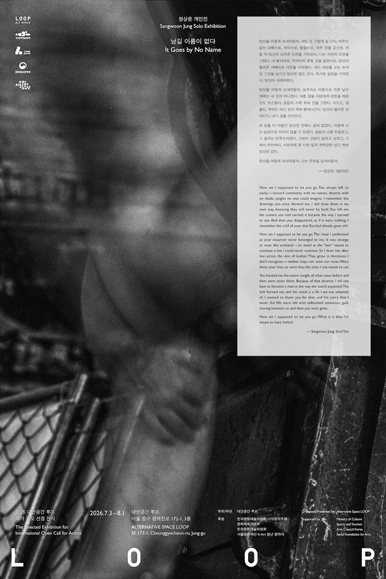
글: 김은서, 대안공간 루프 어시스턴트 큐레이터전시제목정상운 개인전: 남길 이름이 없다
전시기간2026.07.03(금) - 2026.08.01(토)
참여작가 정상운
관람시간10:00am - 07:00pm
휴관일일,월요일 휴관
장르회화, 설치
관람료무료
장소대안공간 루프 ALTERNATIVE SPACE LOOP (서울 중구 청계천로 172-1 3층)
주최대안공간 루프
주관대안공간 루프
후원한국문화예술위원회, 문화체육관광부, 서울문화재단
연락처02-3141-1377
-
Artists in This Show
대안공간 루프(ALTERNATIVE SPACE LOOP) Shows on Mu:umView All
-
정상운 개인전: 남길 이름이 없다
대안공간 루프
2026.07.03 ~ 2026.08.01
-
봄 회화
대안공간 루프
2026.04.04 ~ 2026.05.02
-
Painting-like 그림처럼
대안공간 루프
2025.12.16 ~ 2026.01.31
-
이정 개인전: 캐스퍼
대안공간 루프
2025.08.22 ~ 2025.10.01
Current Shows
-
페르난도 보테로 : 볼륨의 미학 The Triumph of Form
예술의전당 한가람디자인미술관
2026.04.24 ~ 2026.08.30
-
유현경 : Letting Go
여주미술관
2026.05.14 ~ 2026.08.30
-
김사피「하나류」
여주미술관
2026.05.14 ~ 2026.08.30
-
Art+Furniture: 취향이 머무는 자리
광주 신세계갤러리
2026.07.04 ~ 2026.08.30
-
이한비 개인전: 파라다이스 콘도
청년랩
2026.08.01 ~ 2026.08.31
-
21회 장두건미술상 수상작가 안효찬 《친근하면서도, 낯선》
포항시립미술관
2026.06.04 ~ 2026.09.06
-
네이단 콜리: You Will What You Imagine
포항시립미술관
2026.06.04 ~ 2026.09.06
-
어메이징 타일랜드: 태국미술명품전
국립중앙박물관
2026.06.23 ~ 2026.09.06